

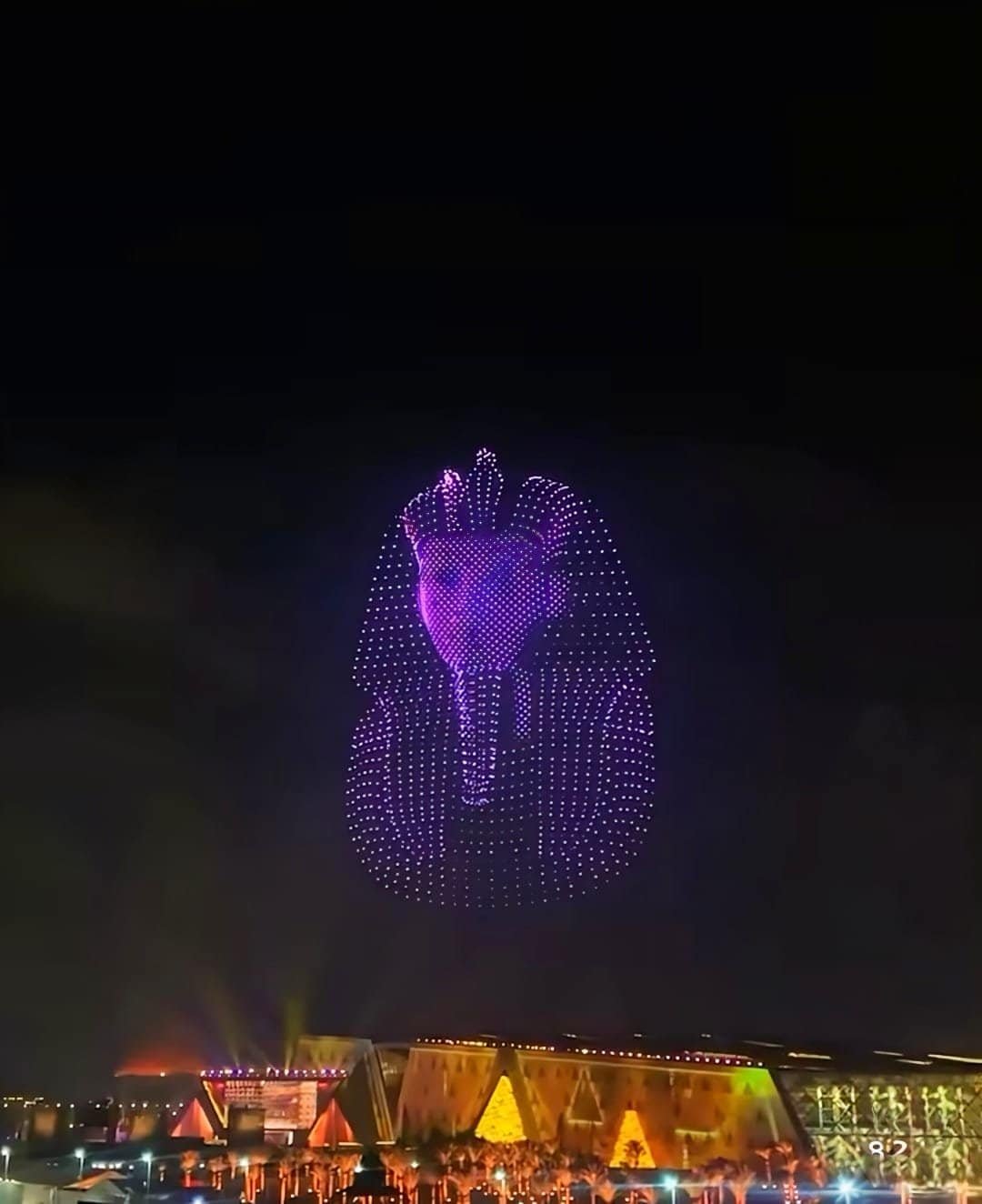
Egypt is blending ancient monuments with modern spectacle — on the plateau of Giza, teams of engineers, archaeologists and designers are deploying holographic and projection systems to create immersive, educational and visually striking experiences around the Pyramids of Giza. The goal is straightforward: use technology to bring history to life while protecting and preserving priceless heritage.
The effort is part storytelling, part conservation and part tourism strategy. Instead of moving fragile objects or altering historic stones, museums and cultural authorities are building precise digital twins — high-resolution 3-D models that can be animated, explored and projected. For visitors, the result is a layered experience: the original stone of the pyramids remains untouched while a luminous, interactive reconstruction plays in front or around it.
Why holograms at the pyramids?
Tourism officials and museum curators are confronting two practical realities. First, modern visitors expect more than static labels and placards — they want context, narrative and engagement. Second, many artefacts cannot be moved or exposed to repeated handling without risk. Holograms and projection systems solve both problems. They offer a way to present accurate visualizations at scale while keeping the original materials safe in climate-controlled storage.
At the Grand Egyptian Museum (GEM), for example, plans for high-definition displays and immersive galleries aim to show artifacts such as the mask of Tutankhamun in greater context, with 3-D reconstructions that display internal details, manufacturing techniques and historic usage. Where the original cannot be exhibited for preservation reasons, a faithful digital twin can offer the public the same experience — often with interactive extras that physical exhibits cannot match.
Core components: projection, models, and surfaces
What makes these shows possible is a layered technical architecture. There are three essential elements:
- High-brightness projection and optics: Outdoor shows require projectors with very high lumen output, often specially adapted to withstand dust and temperature variations. Multiple projectors are used for large canvases, and their outputs are blended via software to create one seamless image.
- Accurate 3-D models and interactive animation: Archaeologists and 3-D artists collaborate to create photorealistic reconstructions. These models are not decorative: they are built from measured scans, archival photographs and expert interpretation.
- Surface engineering: The illusion of a floating hologram depends on careful selection of projection surfaces — from near-transparent scrims to specialized acrylic and glass. In some cases, thin, nearly invisible screens are placed in front of structures so the projected image appears to hover over the stones without touching them.
Software coordinates the entire setup. It handles geometric warping (so the projection fits the 3-D surface), edge blending (to hide seams between projectors), and timing. More advanced systems use sensors and camera feedback to adjust projection alignment in real time — useful if wind or shifting light changes the scene.
How holography and projection differ
In popular language “hologram” and “projection” are often used interchangeably, but the technologies can be distinct. True holography reconstructs light fields so that images appear three-dimensional from many viewpoints. Large public installations more commonly use projection mapping or volumetric displays that create a hologram-like illusion by projecting onto carefully placed surfaces or mist. For large heritage sites, projection mapping is the practical choice: it scales to monumental sizes and works well with existing stone surfaces when properly mapped.
Projection mapping: the technical heart
Projection mapping is the process of aligning projected imagery to the physical contours of a surface. For the pyramids, mapping must take account of stone blocks, irregular textures, and viewer vantage points over a vast area. Technicians use lidar scanning and photogrammetry to create an exact 3-D model of the projection surface. The content is then rendered in software that distorts the image so that, when projected, it looks correct from intended viewing angles.
Because a single projector cannot cover such large surfaces uniformly, multiple projectors are positioned at calculated distances and angles. They overlap slightly and software blends the overlapping zones to prevent visible seams. Color and brightness matching is critical: a mismatch can make the projection look patchy or artificial. The teams calibrate color temperature, gamma curves, and black levels so the projected imagery reads naturally against the stone.
Creating the digital twin
Building a reliable digital twin requires work across disciplines. Archaeologists provide expertise on material properties, historical usage, and stylistic details. Engineers and photogrammetry specialists scan the real object or façade using structured light scanners, lidar, and high-resolution photography. The scans are processed into meshes, cleaned, and retopologized for animation.
3-D artists then texture the models with physically based rendering (PBR) techniques so they respond to light as real materials would. When the animations are produced, they are synchronized to narration, soundscapes and sometimes live actors. When used in a large outdoor installation, animations often include subtle cues that suggest movement of crowds, the sound of chisels, or the shimmer of linen garments — all intended to convey context rather than provide sensational spectacle.
Practical challenges outdoors
Outdoor setups face constraints that indoor museums do not. Ambient light is the main concern: even at dusk, residual sky brightness can wash out projections. That’s why most major shows are scheduled at night and designed with projectors that deliver extreme brightness. Weatherproofing is also required — projectors and electronics must be housed in sealed, climate-controlled cases.
Another practical issue is power and cabling. Large projectors and servers draw significant electrical current; sites need robust, redundant power solutions. Cable runs must be discreet and protected, especially in sites where digging is restricted. Where possible, equipment is placed in temporary enclosures offsite to minimize footprint on archaeological fabric.
Interaction and accessibility
Hologram and projection projects can include interactive elements. For example, sensor zones can trigger supplementary animations as visitors approach, or mobile apps can provide augmented reality overlays that sync with the show. These interactions improve accessibility: audio descriptions, multi-language narration, and tactile kiosks can be integrated so a wide range of visitors gain value.
Accessibility also extends to crowd management. Because the shows are visual draws, organizers design staggered viewing times and physical routes that preserve both visitor safety and site protection. Tickets can be time-stamped to limit groups, reducing wear on sensitive areas.
Conservation benefits
One of the most compelling arguments for projection and holographic experiences is conservation. Fragile artifacts or fragile surfaces are spared direct handling or excessive exposure. Where items cannot be moved into a gallery without risk, their digital replicas can be shown instead. This allows scholars and the public to study and appreciate the object without threatening the original.
Moreover, digital twins can be archived. If an artifact is damaged in the future, high-resolution scans preserve a record. These records are valuable for research, restoration and education, independent of the projection shows themselves.
Economic and social impacts
From a tourism perspective, immersive technology can increase both footfall and dwell time. Visitors stay longer, often paying for VIP experiences or guided tours that feature exclusive projections. Social media sharing of unique visuals drives free publicity. For local economies, the benefits ripple outward: hotels, restaurants, transport and craft vendors see increased revenue.
At the same time, stakeholders must balance commercial interests with integrity. Historian groups and cultural authorities insist that technology not replace critical interpretation. The aim should be to deepen understanding, not to distract from it.
Ethical and interpretive questions
There are legitimate questions about authenticity. A holographic reconstruction inevitably incorporates scholarly interpretation, and different teams may render scenes differently. Transparency is crucial: shows should indicate which elements are speculative and which are based on firm evidence. Museums often address this by including explanatory panels, QR codes with scholarly notes, or companion apps where users can explore the underlying data and source images.
Another ethical dimension involves commercialization. Premium hologram experiences can create inequality if access is limited to those who can pay. Many cultural authorities attempt to mitigate this by offering free viewing times or producing scaled versions suitable for schools and community outreach.
Technologies to watch
Several technical trends promise to improve both fidelity and cost over time:
- Laser projectors: Offer higher brightness, better color stability and longer life, making outdoor projection more reliable.
- LED fan displays and volumetric panels: Create the illusion of floating images without requiring large screens, useful for smaller installations and indoor galleries.
- Real-time rendering engines: Game engines like Unreal and Unity are increasingly used to render high-quality visuals in real time, enabling dynamic interactions and AI-driven guides.
- Edge AI: Localized AI systems can manage interaction, optimize brightness relative to ambient light, or provide voice-activated guides without round-trip latency to distant servers.
Case study examples
Beyond Egypt, projection mapping has been used successfully at heritage sites worldwide. In Italy, projection shows on the Colosseum interpret layered histories; in Peru, augmented reality overlays supplement visits to Machu Picchu; in Japan, projection mapping enhances seasonal shrine festivals. These examples show how the same core technologies adapt to different cultural contexts and conservation needs.
In Egypt, pilot programs emphasize a hybrid approach: small, repeatable indoor hologram exhibits inside the GEM and large outdoor projection shows at the plateau. The GEM approach allows year-round learning with climate control, while the plateau shows provide spectacular evening events that showcase the monuments in new ways.
Preparing content responsibly
Content creation matters. Good shows are researched and scripted by teams that include historians, conservators and local community representatives. Audio narration must be accurate, multi-lingual and sensitive to cultural context. Visuals should avoid sensationalism; their purpose is to inform and engage, not to create a fantasy that supplants real history.
What visitors can expect
A typical modern holographic program at a heritage site will include an introduction to the site’s history, animated reconstructions that reconstruct original appearances, and a closing segment that invites reflection on conservation and the present-day community. Many programs now include companion content for children, interactive timelines, and behind-the-scenes explanations of how digital twins were made.
Future directions and scalability
As costs fall, the technology will scale. Small museums can adopt similar systems using lower-cost projectors and tablets for AR. Remote tours, where holograms or volumetric captures are streamed to classrooms, will widen access. For major sites, new techniques such as aerial projection and drone-mounted displays may one day stage events without touching or encumbering the ground.
In short
🧾 In Short:
- Hologram and projection technologies let heritage sites present accurate, interactive digital twins while protecting originals.
- Projection mapping, lidar scans and photogrammetry create the technical backbone of these systems.
- Outdoor installations require high-brightness projectors, careful calibration and weatherproofing.
- These experiences boost tourism, open new revenue streams and support conservation, but must be developed ethically and transparently.
Watch: Technology Demo
If the video doesn’t load, watch on YouTube.





Leave a Reply