

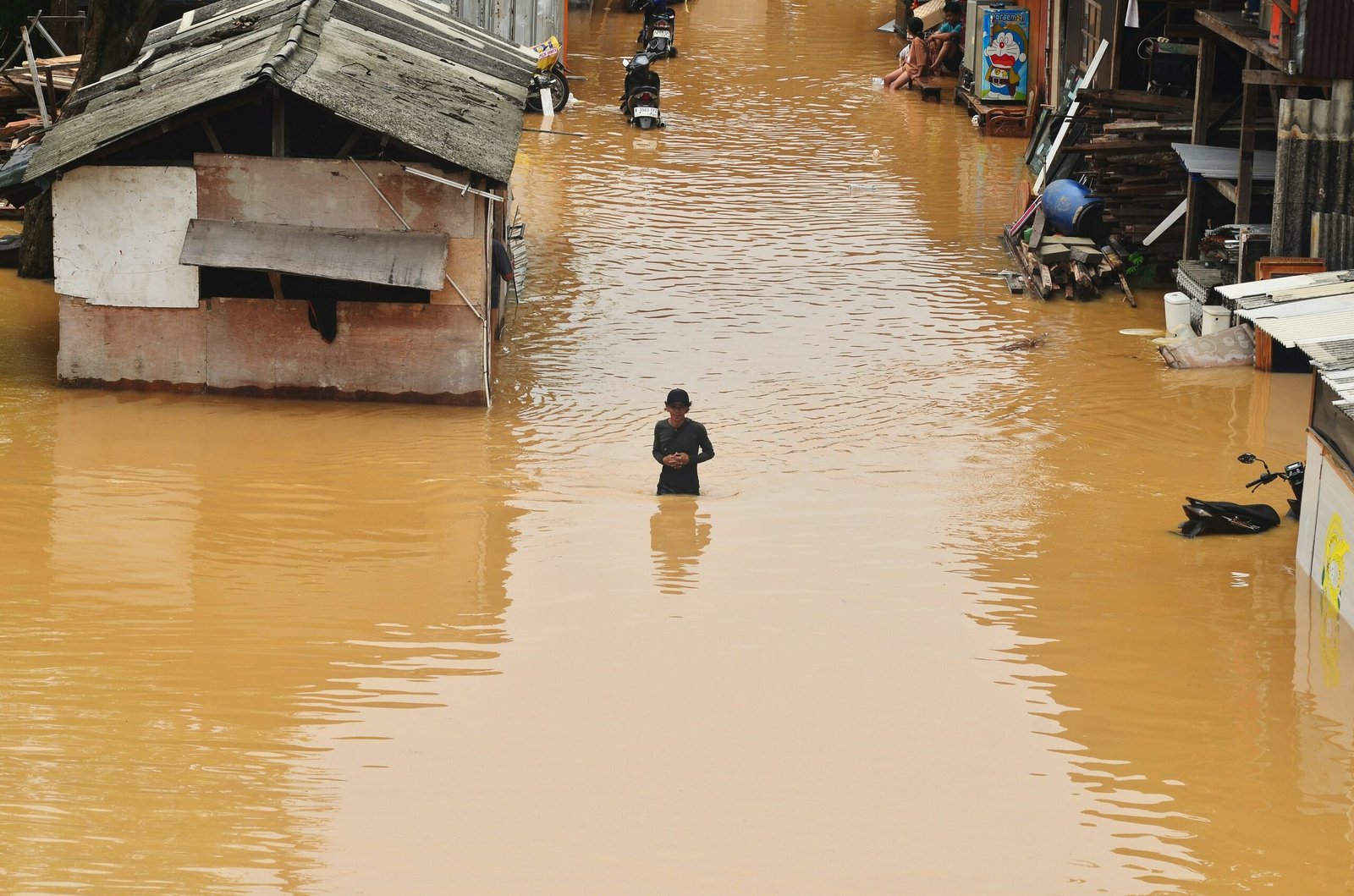
SUMATRA, INDONESIA. Entire communities in western Indonesia are still struggling to reach basic supplies after days of catastrophic flooding left more than 900 people dead and thousands displaced. Many survivors have been forced to walk for hours through broken forest paths, fallen trees, and deep mud just to reach the nearest aid centre. Videos circulating online show families balancing on giant logs, moving slowly across washed-out roads that used to connect their villages to the rest of Sumatra. According to Reuters, many areas remain unreachable due to massive debris blocking every entry route.
Rescue teams say the death toll could still rise as they work to enter remote settlements. Roads that once linked villages have collapsed or disappeared under thick layers of mud, branches, and broken wood. Emergency officials told Reuters their teams are often forced to carry supplies by hand after vehicles get stuck in unstable ground.
Channel News Asia (CNA) described the situation as “slow, exhausting, and frightening,” noting that starvation fears are growing fast. Many families have been waiting near damaged bridges for aid drops, hoping to receive even small bags of rice or bottles of clean water. CNA also reported people surviving on biscuits and whatever dry food they could salvage from flooded houses.
International coverage has also highlighted the scale of the disaster. France24 reported that several villages were partly buried by sudden landslides triggered by the heavy rainfall. Many survivors are now living in temporary shelters made from tarps and scraps of wood. Relief workers told France24 that reaching some shelters could take hours of climbing over unstable hillsides.
The regional media has shown similar scenes. Bangkok Post reported that survivors have been climbing over piles of fallen logs that blocked almost every forest trail. Some walked nearly ten kilometres to find a usable road or reach a relief tent. Many described the journey as “day-long” and “frightening,” especially with trees creaking above them and loose mud under their feet.
Scenes from Indonesia’s flood-hit regions shared widely online
The Indonesian disaster management agency told Reuters that rescue workers are rotating in short shifts because the conditions are physically draining. Teams often carry medical supplies across slippery logs while trying to stabilize their footing on loose ground. Despite the risks, volunteers and local residents continue to support one another, creating chains to move heavier items across narrow paths.
Environmental experts say this disaster has been intensified by years of rapid land changes. CNA quoted a local researcher who explained how deforestation and hillside development made the soil unstable long before the storms arrived. With heavier monsoon rains becoming more frequent, the region faces a tougher challenge each year.
Even so, small signs of progress are appearing. France24 reported that volunteers recently cleared a partially blocked trail, allowing dozens of trapped villagers to reach the nearest aid centre. Some families carried elderly relatives through waist-deep mud, relieved to finally hear the sound of rescue vehicles nearby.
Across social media, videos show villagers forming makeshift rafts, helping each other across raging water, and carrying children through mud-covered roads. These clips have drawn global attention, with people around the world expressing support for Indonesia as the country navigates one of its worst natural disasters in recent memory.
Bangkok Post also warned that continued rainfall may lead to more landslides. Temporary shelters are packed, and doctors are watching for early signs of illness among children. Conditions remain unpredictable, and many communities are still waiting for stable access to food and medicine.
In Short
- More than 900 people have died in Indonesia’s worst flooding in years.
- Survivors are crossing logs, debris, and mud to reach aid centres.
- CNA, France24, Reuters, and Bangkok Post all report major access problems.
- Landslides have buried villages and blocked rescue routes.
- Authorities warn the crisis may worsen if the rain continues.
Expert Q and A
Why is reaching aid so difficult?
Roads are destroyed or buried under trees and mud. Many areas are only reachable by foot, making relief efforts slow and risky.
What did CNA report about starvation fears?
CNA said supply lines are blocked, and many families have not received full meals for days. Relief teams are struggling to reach isolated homes.
Are weather patterns making the situation worse?
Yes. Experts say climate change is intensifying monsoon rainfall, increasing the likelihood of severe flooding and landslides.
How long will full recovery take?
Officials estimate weeks to clear roads and months to rebuild homes and infrastructure across the affected regions.











Leave a Reply