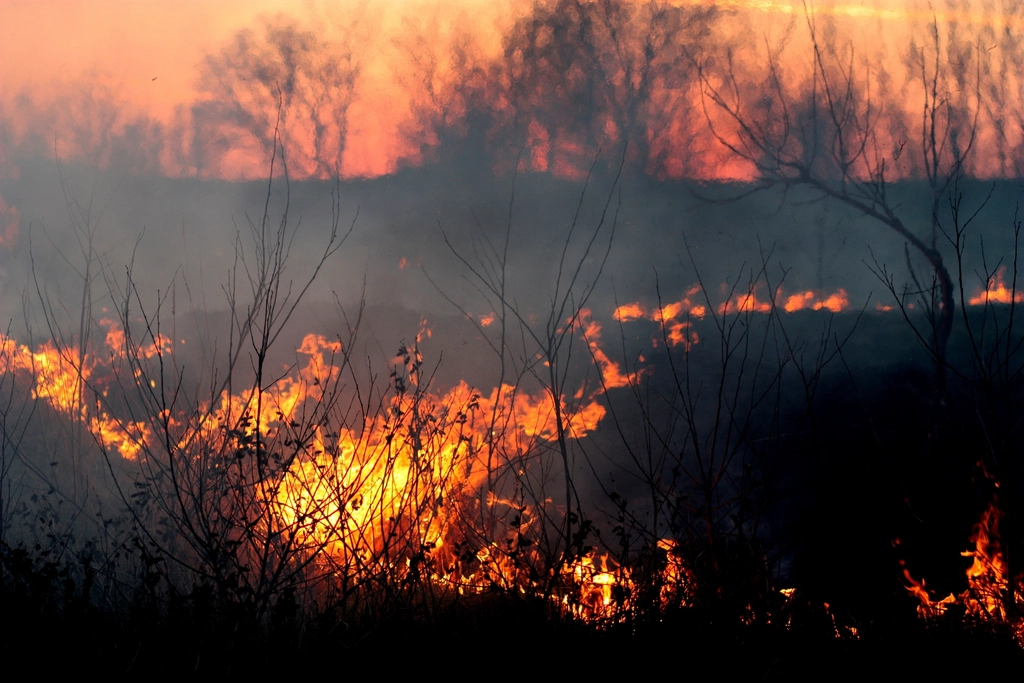
There is a particular kind of image that tells you a wildfire has stopped being a regional emergency and turned into something else. This week it was people on the French Atlantic coast leaving their homes by boat, because the roads were no longer the safe way out.
On Friday, July 24, Spain declared a national emergency over wildfires for the first time in its history, Al Jazeera reported, with two major blazes west of Madrid described by authorities as out of control. Across the border in France, the entire Cap-Ferret peninsula was ordered evacuated. Roughly 87,000 people have now been displaced across the two countries, according to PBS NewsHour.
Spain France: France empties a holiday coastline
The French evacuations are enormous for a country not accustomed to moving people at this scale in the middle of summer. PBS NewsHour reported 44,000 people evacuated in the Gironde department and 23,000 in Landes, roughly 67,000 in total. Al Jazeera, reporting a day earlier on July 23, put the figure above 60,000, and CBS News quoted the interior minister giving a lower number the same week.
Those differences are not really contradictions so much as snapshots of a moving evacuation taken at different hours, and they are worth flagging rather than flattening into one confident number. What is not in dispute is the order itself: the total evacuation of Cap-Ferret, an Atlantic coast tourism hotspot, at the height of the holiday season.
French Interior Minister Laurent Nunez described the operation while it was still under way. As I speak, gradually, 40,000 people have either been evacuated or are currently being evacuated, he said, calling it the largest fire of the season, CBS News reported.
The damage in the Gironde
The Cap Ferret fire burned 125 square kilometres, about 50 square miles. A second French fire further south burned another 25 square kilometres. Forty two firefighters were injured in the Gironde. Around 80 homes burned and roughly 50 of those were destroyed completely.
Officials indicated the Cap-Ferret fire was started by a brush-clearing machine, Al Jazeera reported. Cap-Ferret Mayor Philippe de Gonneville described the core problem as weather that refused to cooperate. The weather is not on our side, he said, with winds that have shifted to the east and northeast.
Spain’s worst in living memory
In Spain the scale is measured differently but reads the same way. Somewhere between 18,000 and 20,000 people in the Madrid region were evacuated or told to shelter indoors, along with another 1,500 in Avila province.
The burn areas are large by any standard. Two merged fires west of Madrid covered 30 square kilometres. A blaze in Avila reached 90 square kilometres. The Guadalajara fire hit 320 square kilometres, about 32,000 hectares, making it one of the largest ever recorded in Spain. Year to date the country has burned roughly 1,140 square kilometres, about 440 square miles.
Madrid Regional President Isabel Diaz-Ayuso called the situation the worst in Madrid’s history. Prime Minister Pedro Sanchez, visiting Guadalajara, was blunter about what he thinks is driving it. Year after year we clearly see how climate change kills and destroys wealth, he said, adding that this is not politics, it is science, it is about facts.
Europe pooling the same small fleet
The response has gone continental. President Emmanuel Macron invoked the European Union’s civil protection mechanism, warning that the crisis remained very intense. France received two Croatian Canadair aircraft, two Portuguese Air Tractors, and two Black Hawk helicopters from the Czech Republic and Slovakia.
Spanish Interior Minister Fernando Grande-Marlaska said Italy and Greece were each sending two Canadair water-dumping planes, Al Jazeera reported. When half a dozen countries are shuttling the same modest pool of firefighting aircraft across borders, that tells you the fire season has outrun what any one national fleet was built for.
The heat underneath all of it
The fires are sitting on top of an extreme heatwave. Temperatures in the affected zones ran above 39 to 40 degrees Celsius, about 104 Fahrenheit, with Mediterranean forecasts of 42 to 44 degrees. Spain’s meteorological agency AEMET declared wildfire danger very high or extreme across mainland Spain and the Balearic Islands.
The human cost of that heat is already measurable quite apart from the fires themselves. France recorded 5,764 excess deaths between June 17 and July 2 during the earlier heatwave, per Al Jazeera. Thirteen people died in a southern Spain wildfire earlier this month, and one firefighter died in Sicily.
On firefighter deaths this week the reporting genuinely diverges, with different outlets giving different tolls for what may well be overlapping incidents. We are not adding those figures together into a single number, because doing so would invent a total that no source actually supports.
Why This Matters
A national emergency declaration is a legal and administrative act, not a headline flourish. Spain has had bad fire years before and never reached for this particular lever. That is the signal worth reading: the state is saying out loud that its normal regional machinery is not enough for what is burning.
The second signal is the calendar. This is late July. The Mediterranean fire season has historically peaked in August. Spain has already burned 440 square miles and declared an emergency, and France has evacuated an entire peninsula, before the traditional worst of the season even arrives.
The aircraft sharing is the quiet tell underneath both. Croatia, Portugal, the Czech Republic, Slovakia, Italy and Greece are lending planes and helicopters because no single country keeps enough of them for a summer like this. That arrangement works right up until two countries need the same aircraft in the same week.
The NewsSparq Takeaway
Three things to hold onto.
One, Spain crossed a line it had never crossed before. The first national emergency declaration for wildfires in the country’s history, with two blazes west of Madrid out of control and the regional president calling it the worst in Madrid’s history.
Two, the displacement landed on a holiday coastline. The total evacuation of Cap-Ferret, tens of thousands moved across Gironde and Landes, some leaving by boat, and about 87,000 people displaced across the two countries.
Three, the heat is the engine. Temperatures above 40 degrees Celsius, extreme fire danger declared across mainland Spain and the Balearics, and 5,764 excess deaths already recorded in France during this summer’s earlier heatwave.
People left a French beach town by boat this week because the road out was not an option. That is the image to keep in mind when the season actually peaks next month.
Sources: PBS NewsHour, CBS News, Al Jazeera, Al Jazeera, France evacuations, Al Jazeera, Spain and France.
By Md Danish, Founder and Editor in Chief, NewsSparq
Related Stories From NewsSparq
- Researchers Just Caught the First Ransomware Attack Run Entirely by an AI, With No Human at the Keyboard
- The Dow Just Closed Above 53,000 for the First Time, and an iPhone Factory Lit the Fuse
- The Dow Just Closed Above 52,000 for the First Time, and Alphabet Did Most of the Heavy Lifting
- Silicon Valley Just Bankrolled Americas First Offensive Cyber Warfare Startup at a $1 Billion Valuation