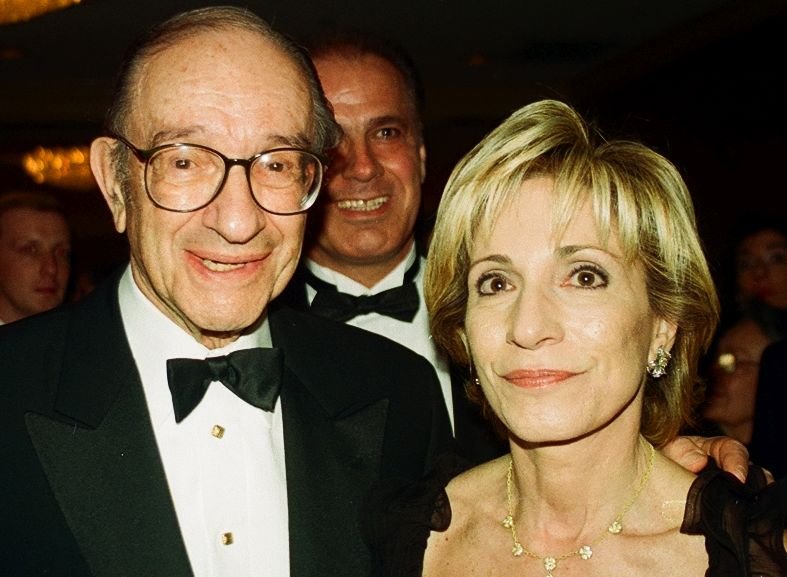
For 18 years, longer than any other Federal Reserve chair before or since, Alan Greenspan held the most consequential unelected job in American economic life. He set interest rates, shaped monetary policy, and spoke in a language so deliberately opaque that Wall Street traders spent careers learning to decode the Delphic art of reading Greenspan.
He died Monday at his home. He was 100. His wife, NBC journalist Andrea Mitchell, confirmed he died from complications of Parkinson’s disease.
Who Greenspan Was
Per NBC News, Greenspan served under four presidents, from Ronald Reagan through George W. Bush, from 1987 to 2006. During that stretch he presided over one of the longest economic expansions in US history, a boom that stretched from 1991 to 2001 with only brief interruptions. Markets trusted him so completely that a generation of investors came to believe that a kind of protective hand was over American finance. It became known as the Greenspan put.
Per NPR, he was celebrated during his chairmanship as possibly the best central banker in history. That reputation was immense while it lasted.
The Expansion That Made His Name
The 1990s were the Greenspan decade in the way that few economic periods belong to a single policymaker. The US economy grew without significant recession for nearly the entire decade. Technology was booming. Inflation stayed low. Unemployment fell. The budget went from deficit to surplus. Greenspan was not the cause of all of it, but he was at the center of the institution that kept the money supply stable while all of it happened.
His communication style was part of the legend. When Greenspan spoke before Congress, traders and economists would pull apart every syllable looking for a hint about the next rate move. He gave them very little to work with by design. The ambiguity was a tool. He believed that markets moved better when they could not fully predict the Fed.
The Crisis That Complicated Everything
Per CNBC, Greenspan’s reputation was later tarnished by the worst financial crisis since the Great Depression. The 2007-2008 financial crisis, which followed years of loose lending standards, complex derivatives, and inflated housing prices, came after Greenspan had spent years advocating for financial deregulation.
In 2008, he testified before Congress and made one of the most remarkable statements any central banker has ever delivered in public. He said he had found a flaw in his model of how the world worked. For decades he had believed that financial institutions, acting in their own self-interest, would regulate themselves because they understood that reckless behavior would destroy them. The crisis proved otherwise. His faith in self-regulation, in the rational self-correction of markets, had been wrong.
The Deregulation Legacy
Per Axios, critics faulted Greenspan for advocating the deregulation of financial instruments, particularly derivatives, and for keeping interest rates low in the early 2000s in ways that may have inflated the housing bubble. His 2008 testimony, in which he admitted the flaw in his model, was a rare and striking moment of self-examination from someone of his stature.
Supporters argue that the crisis was caused by factors well beyond any single regulator’s control, and that the deregulation Greenspan championed also produced decades of financial innovation and growth. Both things can be true. The debate over what the Greenspan era actually got right and wrong has been running for nearly 20 years and is unlikely to be resolved soon.
The Maestro Tag That Stuck and Then Burned
Bob Woodward’s 2000 biography called him The Maestro, and the nickname captured exactly how the establishment saw him at his peak. He was the conductor of the largest economy in the world, the man whose hand on the rate dial shaped whether Americans could afford mortgages, whether businesses could borrow to expand, whether the dollar held its value against the world.
By 2008, the same word felt ironic. The maestro had missed the largest financial catastrophe since the 1930s. The question that historians and economists will argue about is whether he helped cause it, whether he could have prevented it, or whether the crisis would have happened regardless of who was in his chair. The answer is probably yes to all three in different proportions, which is the unsatisfying complexity that tends to surround truly consequential people.
What He Left Behind
The institution he left behind is stronger in some ways than when he found it, with a clearer mandate, more communication tools, and a framework for crisis response. The stress tests that now run banks through hypothetical disasters, the forward guidance that tells markets where rates are likely to go, the direct intervention tools used in 2008 and again in 2020, all of these came partly out of lessons learned or forced by what happened during his era.
The Fed that Kevin Warsh now chairs is different from the one Greenspan inherited from Paul Volcker. It is more transparent. It communicates more. It acts faster. Whether that is entirely because of Greenspan or partly in spite of him depends on which chapter of his tenure you are reading.
A Life That Spanned the American Century
He was born in 1926. He lived through the Depression, the Second World War, the Cold War, the technological revolution, the financial crisis, and the beginning of the AI era. He played jazz professionally as a young man. He was a protege of Ayn Rand, whose philosophy of rational self-interest shaped his early thinking about markets. He was appointed by Reagan, reappointed by George H.W. Bush and Clinton and George W. Bush. He survived four presidencies and became one of the longest-serving central bankers of the modern era.
He turned 100 in March 2026. He died in June. The man who ran American money longer than anyone else was gone before the summer was over.
The NewsSparq Takeaway
Three things to hold onto.
One, his expansion was real. The 1990s boom was genuine, long, and broadly shared. That does not erase what followed, but it does not get erased by it either.
Two, the 2008 admission mattered. Very few people in his position ever say they were wrong about something this large. That testimony will follow his name as long as it is studied.
Three, the debate is not over. Economists and historians will spend decades more arguing about what the Greenspan era actually did to American finance. He was too central, for too long, for the verdict to be simple.
Alan Greenspan shaped the United States’ relationship with money for nearly two decades. He died the same week his successors were still cleaning up disagreements about how to handle the consequences of what he built. That is a complicated legacy. Most consequential ones are.
Sources: NBC News, NPR, CNBC, Axios.
By The NewsSparq Editorial Desk
Related Stories From NewsSparq
- A New Man Just Took Over the Federal Reserve, and Your Mortgage Is Waiting to See What He Does
- The Man Who Co-Wrote the Paper That Started the AI Revolution Just Changed Sides
- Startup Money Is Moving Again in June, but the Rules Have Changed Completely
- Startup Money Is Flowing Again, but Only Into the Boring Stuff That Powers AI